How to Share the Mental Load at Home Without Constant Reminders
Practical ways for couples and families to share the invisible work of running a home, with clear ownership and fewer reminders.
Running a home involves much more than completing visible chores. Someone also has to remember that groceries are running low, a school form is due, a doctor’s appointment needs to be booked, dinner has to be planned and a family member must be reminded about an upcoming task.
This invisible planning work is often called the family mental load.
The mental load becomes stressful when one person is expected to notice, remember, plan, assign and follow up on everything. A more balanced household does not simply divide chores. It shares responsibility for the complete process.
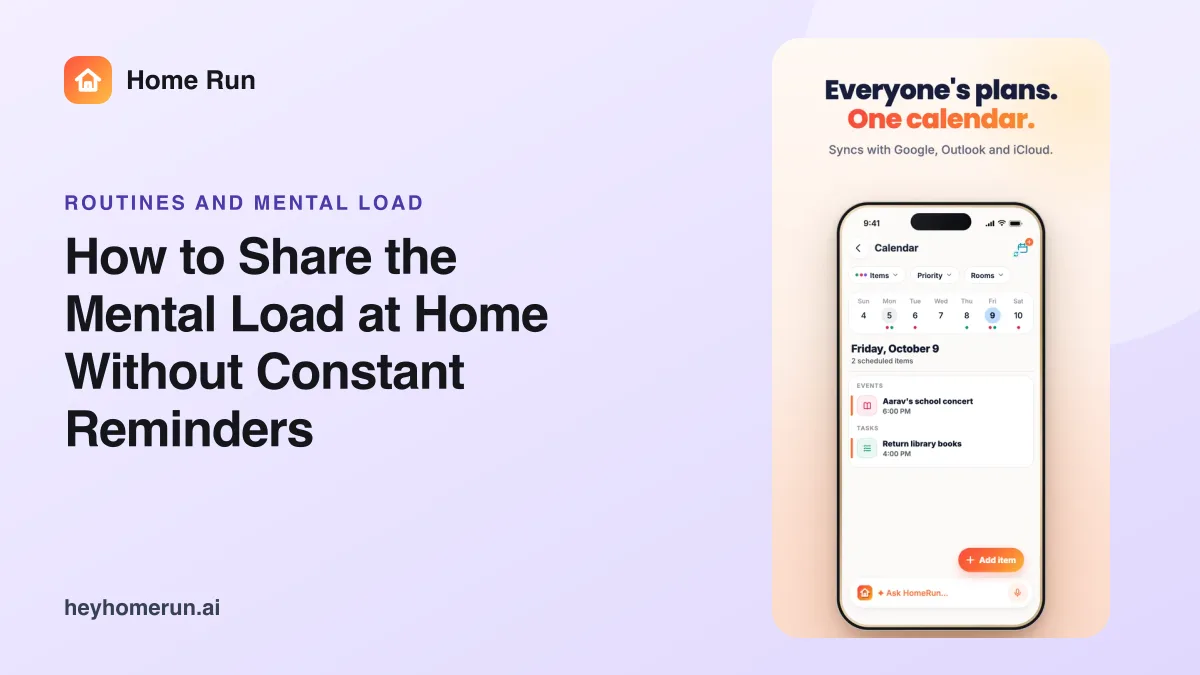
Home Run helps families bring household tasks, meals, reminders, documents and updates into one private family AI operating system, making responsibilities easier to see and share.
What Is the Family Mental Load?
The family mental load is the ongoing responsibility of thinking about what a household needs.
It includes questions such as:
- What food needs to be purchased?
- Which school deadline is coming next?
- Who is attending the appointment?
- Has the electricity bill been paid?
- What should be prepared for tomorrow?
- Did anyone inform the helper about the change?
- Where is the document that the family needs?
Completing a task is only one part of the work. Someone must first notice that the task exists, decide what should happen, communicate it and confirm that it was completed.
That is why saying “just tell me what to do” may not reduce the burden. The planning responsibility still remains with the same person.
Why Do Household Responsibilities Become Unbalanced?
Household responsibility often becomes concentrated because information is scattered.
A school update may be in an email. A grocery request may be in a family chat. A doctor’s report may be stored on one phone. A reminder may exist only in one person’s memory.
When information is fragmented, the person who understands the full household context becomes the default coordinator.
This creates three common problems:
1. One Person Becomes the Household Memory
The family depends on one member to remember every deadline, preference and commitment.
2. Family Members Wait for Instructions
Other members may be willing to help, but they do not have enough visibility to act independently.
3. Repeated Follow-Ups Create Frustration
The household coordinator has to repeatedly ask whether something was seen, accepted or completed.
A shared household system can reduce these problems by making the plan visible to everyone who needs it.
How Can Families Share the Mental Load More Fairly?
Give Every Responsibility a Clear Owner
“Someone should buy groceries” is not a complete plan.
A better task includes:
- What needs to be done
- Who is responsible
- When it should be completed
- Any notes or documents required
- Whether the task is pending or complete
Clear ownership prevents several people from assuming that someone else will handle the task.
Share the Information, Not Only the Instruction
A person can take ownership only when they have the necessary context.
Instead of saying:
“Please handle the school activity.”
Include the relevant details:
“The school activity is on Friday at 10:00 AM. The permission form is attached, and it needs to be submitted by Wednesday.”
Home Run can keep tasks, reminders, documents and family updates connected so that a responsibility does not depend on a separate explanation.
Use One Shared Source of Truth
Families often lose time deciding which message, note or calendar entry is current.
A shared family system should answer:
- What is happening?
- Who is handling it?
- What changed?
- Which document is relevant?
- What remains incomplete?
Home Run is designed to bring household planning into private shared spaces so family members can work from the same information.
Turn Decisions Into Actions
A family discussion is useful, but the final decision must become an actionable plan.
For example, after discussing the weekend, the family may decide:
- Saturday lunch will be at home
- Groceries must be purchased on Friday
- One child has a sports activity
- A relative needs to be picked up
- The helper should be informed about the schedule
Each decision should become a task, event, reminder or family update rather than remaining inside the conversation.
Avoid Making One Person the Permanent Manager
Fair responsibility means allowing different family members to manage complete areas of household life.
One person might own the weekly grocery flow. Another may handle school administration. Someone else can coordinate appointments or recurring bills.
Ownership should include planning and follow-through, not only execution.
A Simple Weekly Mental-Load Check-In
Families can spend ten minutes each week reviewing five questions:
- What is happening this week?
- Which tasks require preparation?
- Who owns each responsibility?
- Which documents or purchases are needed?
- What information should be shared with the family?
The goal is not to create a formal meeting. It is to prevent one family member from privately carrying the entire week in their head.
Home Run can support this routine by keeping meals, shopping, school tasks, reminders, care information, documents and updates in one household system.
How AI Can Reduce Household Follow-Up
AI is most useful when it removes administrative effort without removing family control.
A family member may write:
“Add the school presentation for Thursday, remind us on Wednesday evening and create a task to buy chart paper.”
This single instruction contains an event, a reminder and a shopping task.
Instead of manually entering each item into separate tools, a family AI assistant can help organize the request into the appropriate household workflow.
The family still decides what should happen. AI reduces the effort required to record and coordinate it.
What Home Run Adds to Family Coordination
Home Run is built around a simple idea: a family should be able to run the home like a team.
It provides a private space where household members can organize:
- Tasks and responsibilities
- Meals and shopping
- School activities
- Calendars and reminders
- Care information
- Documents
- Family conversations and updates
When the household plan is shared, family members can participate without waiting for repeated instructions.
Frequently Asked Questions
What is the mental load in a family?
The family mental load is the invisible work of remembering, planning, coordinating and following up on household responsibilities.
How can couples divide household responsibilities fairly?
They can assign complete areas of ownership, share the relevant information and use a common system where tasks and deadlines are visible.
Can a family organizer reduce the mental load?
Yes. A shared organizer can reduce dependence on one person’s memory by making tasks, responsibilities, reminders and updates visible to the household.
Is Home Run only a family to-do list?
No. Home Run connects tasks with meals, shopping, school activities, reminders, care records, documents and family updates inside a private family AI operating system.
Can children or caregivers participate?
Household members and caregivers can participate according to the access and responsibilities assigned within the family’s private spaces.
Share the Plan, Not Just the Chores
The mental load becomes lighter when the entire household can see what needs to happen and participate with the right context.
Home Run helps families replace private mental checklists and repeated reminders with shared household clarity.
When the plan is visible, running the home becomes a team effort—and everyday family life feels more like a Home Run.